We think Mr. Himes is particularly vulnerable this election. His party has been ineffective on domestic and foreign policy and Himes has voted with his party 93% of the time.
He seems to be struggling recently.
Mr. Himes bravely voted against the Obama budget (after six years of voting for essentially the very same budget) because he wants to bring fiscal discipline to Washington.
Mr. Himes was against the Patriot Act, until he was against the Amash Amendment that would have emasculated the Patriot Act, until he was for the FREEDOM Act that would replace parts of the Patriot Act.
It's good he is scared. We think he is at risk.
Saturday, June 21, 2014


Friday, June 20, 2014
Why Does Jim Himes Support Warrantless NSA Searches?
In what’s being billed as a momentum boost for anti-surveillance advocates, the US House of Representative on Thursday approved an amendment that significantly reigns in warrantless searches on Americans’ communication records.
By a vote of 293 to 123, a bipartisan coalition in the House voted to ban the National Security Agency from conducting “backdoor searches” on United States citizens, a process that allowed the intelligence community to collect data on Americans without a warrant as long as the official target was a foreigner. The program was first revealed by the Guardian, through documents leaked by Edward Snowden.
Jim Himes was against the Patriot Act, until he was against the Amash Amendment that would have emasculated the Patriot Act, until he was for the FREEDOM Act that would have replaced parts of the Patriot Act, until he was against the Massie Amendment which is the subject of the story above.
Can Jim Himes tell us where he stands on the Fourth Amendment? Then stick to it?
Chris Murphy: Meet Walter Mondale
Chris Murphy is channeling Walter Mondale:
We only hope Mr. Murphy meets the same fate in 2018 as Mr. Mondale did in 1984.
Sens. Chris Murphy (D-Conn.) and Bob Corker (R-Tenn.) on Wednesday unveiled the first bipartisan Senate proposal to raise the gas tax, broaching a dangerous political issue that lawmakers have avoided for years.
The Murphy-Corker plan would raise the gas tax by 12 cents over the next two years, raising $164 billion over the next decade and covering the shortfall in the Highway Trust Fund.
We only hope Mr. Murphy meets the same fate in 2018 as Mr. Mondale did in 1984.
Sunday, September 8, 2013
Jim Himes Bravely Asks Darien Residents to Express Their Overwhelming Opposition to Bomb Syria
Jim Himes today asks his constituents, at the Darien Library, for their thoughts on President Obama's request to bomb Syria. How brave of the Congressman. Polls show overwhelming opposition to getting involved in Syria. It is doubtful the congressman's constituents are much different.
Where was the Congressman's town hall when the vote for the Affordable Care Act was pending? Where was the Congressman's town hall when the Amash Amendment, which would have emasculated the Patriot Act, was pending? In a completely inexplicable turnabout, Himes, who voted AGAINST the Patriot Act voted AGAINST an Amendment that would have crippled the Patriot Act. Where was the Congressman's town hall when the Obama administration forced church's to violate their conscience?
On the tough votes the Congressman hides. On the easy votes he asks our opinion. Congressman Himes has been a disappointment with his leading from behind strategy and lock-step voting with Nancy Pelosi. Today's meeting at the Darien Library is further evidence of this.
Monday, July 29, 2013
Jim Himes Joins Bipartisan Effort to Spy on US Citizens
Jim Himes loves to bemoan the lack of bipartisanship in Washington. Good news everyone, Mr. Himes joined in the bipartisan effort to allow the NSA to spy on US citizens by voting against the Amash Amendment.
According to the NY Times
Himes joined Nancy Pelosi (D), Steny Hoyer (D), John Boehner (R), Eric Cantor (R) in voting against the clearly dangerous and illegal subversion of our right to privacy and voting for general warrants.
http://clerk.house.gov/evs/2013/roll412.xml
Mr. Himes is against the Patriot Act, but for allowing the NSA to spy on you.
According to the NY Times
In one of the most unusual votes in years, the House on Wednesday barely defeated an amendment to curtail the National Security Agency’s collection of every phone record, limiting it to records of people targeted in investigations.Imagine that, only allowing the NSA, which until the Patriot Act was restricted from spying on US citizens, to only spy on people targeted in investigations?
Himes joined Nancy Pelosi (D), Steny Hoyer (D), John Boehner (R), Eric Cantor (R) in voting against the clearly dangerous and illegal subversion of our right to privacy and voting for general warrants.
http://clerk.house.gov/evs/2013/roll412.xml
Mr. Himes is against the Patriot Act, but for allowing the NSA to spy on you.
Monday, June 10, 2013
Senator Blumenthal: Tough on the Issues
Look at Senator Blumenthal's Twitter page, for his views on the DoJ's subversion of the Free Press, the IRS attack on free speech and the NSA's spying on domestic citizens.
He is silent on those issues on his Twitter account.
Check his Facebook page for his views on these issues.
He is silent on these issues on his Facebook page.
Check his website for his views. Check the Issues tab, and the Newsroom tab. He is again silent on these issues.
But the good news is this:
According to the NY Times Senator Blumenthal decided not to vote on the Patriot Act extension. He voted for the extension of FISA
Dick Blumenthal, protecting Nickelodeon watchers from unhealthy food.
He is silent on those issues on his Twitter account.
Check his Facebook page for his views on these issues.
He is silent on these issues on his Facebook page.
Check his website for his views. Check the Issues tab, and the Newsroom tab. He is again silent on these issues.
But the good news is this:
Blumenthal Issues Letter Calling on Nickelodeon to Prohibit Advertisements that Market Unhealthy Food to ChildrenThat's quite a relief. For a second I thought he wasn't paying attention to some of the important issues of the day.
According to the NY Times Senator Blumenthal decided not to vote on the Patriot Act extension. He voted for the extension of FISA
Dick Blumenthal, protecting Nickelodeon watchers from unhealthy food.
Saturday, June 8, 2013
Himes Against NSA snooping except when he's for it
Jim Himes is Shocked! Shocked there is gambling in Casablanca!
He decries the overreach of the NSA domestic spying program but doesn't mention he voted FOR the extension of the FISA Amendments Act
Good for Mr. Himes for voting against the Patriot Act. It's too bad his commitment to liberty didn't extend to voting against FISA.
He decries the overreach of the NSA domestic spying program but doesn't mention he voted FOR the extension of the FISA Amendments Act
“a law so broad and vague that, despite its passage four years ago, we still have little idea how the government is using it.”
Good for Mr. Himes for voting against the Patriot Act. It's too bad his commitment to liberty didn't extend to voting against FISA.
Friday, January 18, 2013
Note to Choose to Reuse:
Note to Choose to Reuse. See below:
Grocery Bag Bans and Foodborne Illness
Jonathan Klick
University of Pennsylvania Law School; Erasmus School of Law; PERC - Property and Environment Research Center
Joshua D. Wright
George Mason University School of Law
November 2, 2012
Abstract:
Recently, many jurisdictions have implemented bans or imposed taxes upon plastic grocery bags on environmental grounds. San Francisco County was the first major US jurisdiction to enact such a regulation, implementing a ban in 2007. There is evidence, however, that reusable grocery bags, a common substitute for plastic bags, contain potentially harmful bacteria. We examine emergency room admissions related to these bacteria in the wake of the San Francisco ban. We find that ER visits spiked when the ban went into effect. Relative to other counties, ER admissions increase by at least one fourth, and deaths exhibit a similar increase.
Number of Pages in PDF File: 23
Keywords: plastic, environment, pollution, e-coli
JEL Classification: I18, K32
Monday, November 12, 2012
Brother Can You Spare $300 Million,
From my friend Bill Knabe at the Bipartisan Soapbox
Oops. Connecticut is coming up short of funds, upwards of $300 million, for its fiscal 2013 budget. Governor Malloy is between a $300 million rock and a promise to not raise taxes hard spot.
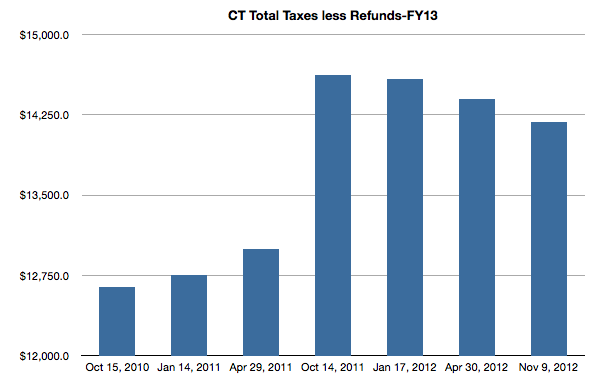
The story in the link portrays this as something of a surprise, but it's not. The source of this forecast is something called the Connecticut Consensus Revenue Report. They arrive three times a year and give out year projections of the expected revenues from taxes, other revenue (gaming payments, licenses, transfers) and other sources, mostly Federal grants. The graph below shows the estimated "Taxes less refunds" the biggest chunk, about $15 billion, of the $21 billion total CT revenue expected for FY13. You can see the big Malloy tax increase in October of 2011 and you can see the forecast was optimistic from the very start. The current estimate of total taxes less refunds is $439 million lower than originally expected.
 But not to worry. Let's tax the rich. After all, Keith Richards has a house in Connecticut and surely he wouldn't mind paying more of his fair share.
Brother can you spare $300 million?
Oops. Connecticut is coming up short of funds, upwards of $300 million, for its fiscal 2013 budget. Governor Malloy is between a $300 million rock and a promise to not raise taxes hard spot.
The story in the link portrays this as something of a surprise, but it's not. The source of this forecast is something called the Connecticut Consensus Revenue Report. They arrive three times a year and give out year projections of the expected revenues from taxes, other revenue (gaming payments, licenses, transfers) and other sources, mostly Federal grants. The graph below shows the estimated "Taxes less refunds" the biggest chunk, about $15 billion, of the $21 billion total CT revenue expected for FY13. You can see the big Malloy tax increase in October of 2011 and you can see the forecast was optimistic from the very start. The current estimate of total taxes less refunds is $439 million lower than originally expected.

Thursday, April 5, 2012
What is it about oil prices that results in politicians taking leave of their senses?
Earlier this week Bob Duff sent a letter to Congress, "Urging Swift Action to Fight Oil Speculation." Duff says, "“We have done what we can at the state level to protect consumers. Now we ask Congress and President Obama to take the torch and crack down on irresponsible oil speculators on Wall Street.”
Carlo Leone, echoes Duff's sentiments and congratulates himself on stopping the prices from going higher.
Almost all of the Connecticut Congressional delegation has come out against Wall Street speculation driving oil prices higher. Jim Himes has been silent on the issue. We congratulate him in not joining the inanity of his colleagues.
It's embarrassing. What is it about oil prices that results in politicians taking leave of their senses. Do we really have to waste more time and energy in another useless investigation that shows oil prices respond to market dynamics. We have never discovered the boogeyman speculator politicians have conjured up.
We frequently disagree with Duff and Leone. But we always thought they were smarter than this. Maybe not. Bob, Carlo, do you really have to be so silly?
Tuesday, April 3, 2012
Lierbman wants to save Post Office. What next? Bring back Pony Express?
The Connecticut Mirror reports Joe Lieberman wants to save the US Post Office. Our first reaction was, Why? We may as well try to resurrect the Pony Express.
"We're trying everything we can to save this great institution," said Lieberman. This is the same insitution that raises prices for less service and the same one that is increasingly irrelevant due to email, text messaging, FedEx and UPS? The one that is going bankrupt? That great institution? Let it go. Sell the real estate and the little trucks. Use the proceeds to fund the pension obligation. Turn off the lights.
Monday, February 20, 2012
How Solar Subsidies Wastes Money, Increases Electricity Prices and Hurts the Poor
The CT Mirror has a story today on Connecticut's solar subsidy program, "Controversy flares in new solar program for homeowners." In our rush to pat ourselves on the back for being green, what we ignore is solar subsidies wastes money, increases electricity prices and hurts the poor.
The gist of the story is solar subsidies aren't big enough and don't last long enough. That is, the pigs at the trough want more and more and more. From their perspective it is entirely fair for the average ratepayer to pay more for electricity in order to subsidize their business.
The math just doesn't work. Connecticut ratepayers pay about 18.26 cents per kilo watt hour for residential electricity. (see page 6). The relevant metric in solar is "levelized costs" which is the equivalent cost per kilo watt hour for a solar system over the life of the system. Levelized costs will vary based on the cost of the solar system, the installation costs, the efficiency of the system and the amount of sun the system can collect. In Connecticut the levelized costs for a solar system is about 30 cents per kilowatt hour. In order to make a solar system competitive what the government has to do is make sure everyone doesn't get a fair shot, everyone doesn't do their fair share, and everyone doesn't play by the same rules, to coin a phrase.
The system is rigged in Connecticut in three ways. First there is "The Combined Public Benefits Charge represents a combination of three charges formerly known as: "Conservation and Load Mgmt Charge, Renewable Energy Investment Charge, and Systems Benefits Charge."That is, we pay a direct fee to subsidize solar energy, it's about 3% of our electric bill. Second the state mandates the amount of electricity that must be generated by renewable energy. This results in less investment for natural gas and other traditional power sources, which are lower cost than solar and wind. Third, the state gives direct subsidies to solar producers and residential customers to install solar.
We end up then with higher costs, to subsidize a politically connected group of businesses to install solar systems mostly on homes of high net worth residents (the average costs of a residential solar system tops $40,000) and the poor get hurt most since electricity is a bigger part of their budget.
The gist of the story is solar subsidies aren't big enough and don't last long enough. That is, the pigs at the trough want more and more and more. From their perspective it is entirely fair for the average ratepayer to pay more for electricity in order to subsidize their business.
The math just doesn't work. Connecticut ratepayers pay about 18.26 cents per kilo watt hour for residential electricity. (see page 6). The relevant metric in solar is "levelized costs" which is the equivalent cost per kilo watt hour for a solar system over the life of the system. Levelized costs will vary based on the cost of the solar system, the installation costs, the efficiency of the system and the amount of sun the system can collect. In Connecticut the levelized costs for a solar system is about 30 cents per kilowatt hour. In order to make a solar system competitive what the government has to do is make sure everyone doesn't get a fair shot, everyone doesn't do their fair share, and everyone doesn't play by the same rules, to coin a phrase.

The system is rigged in Connecticut in three ways. First there is "The Combined Public Benefits Charge represents a combination of three charges formerly known as: "Conservation and Load Mgmt Charge, Renewable Energy Investment Charge, and Systems Benefits Charge."That is, we pay a direct fee to subsidize solar energy, it's about 3% of our electric bill. Second the state mandates the amount of electricity that must be generated by renewable energy. This results in less investment for natural gas and other traditional power sources, which are lower cost than solar and wind. Third, the state gives direct subsidies to solar producers and residential customers to install solar.
We end up then with higher costs, to subsidize a politically connected group of businesses to install solar systems mostly on homes of high net worth residents (the average costs of a residential solar system tops $40,000) and the poor get hurt most since electricity is a bigger part of their budget.
Friday, February 17, 2012
CCEA Outlook Combines Bad Writing and Bad Economics
We were puzzled by the CT Mirror story, "State projects could play key role in accelerating economic recovery in 2012," because it put forth a rather inane concept that a state could accelerate economic growth by taking money out of one pocket and putting it into another pocket. Since the State must balance its budget, all spending must be funded by increased spending or increased borrowing. And since borrowing must be paid back, and with interest, taxes will go up to fund that. Robbing Peter to pay Paul is not a legitimate economic theory.
The story was based on a report, "Outperforming the Nation: Is it Sustainable?" by CCEA, the Connecticut Center for Economic Analysis. We strive to be civil in this column, but there's no way to be polite about this report. The writing is awful. It's worse than awful.
The title page states, "This CCEA Outlook explores policies for ensuring the State of Connecticut’s recovery continues to outpace the Nation’s." There is this sentence, "Though still early in development of the Biosciences Connecticut complex, the major research building that will house Jackson Laboratories on the Farmington campus, and construction of the New Britain-Hartford busway, each will clearly strengthen the state’s economic performance significantly, by nearly 1% in 2012 and 1.15% in 2013." Chart 3 is labeled, "Employment Growth Eschewing and Including Low Interest Rates." And on it goes.
Awful writing. Awful economics.
Sunday, February 12, 2012
Where the CT Delegation Stands on HHS Ruling Against Catholic Church
If anyone can find Jim Himes' opinion on the policy that will force Catholic run hospitals and charitable organizations to offer services that violate the Church's teaching, please let us know.
In late January, the Department of Health and Human Services (HHS), as part of the Affordable Care Act, also known as ObamaCare, ruled employers must offer contraceptive services to their employees as part of their health care plans. The Catholic Church objected, stating it was against Church doctrine for Church-run organizations like hospitals and charities, to offer contraceptive services to employees. The White House offered a compromise on February 10th, that is best summarized by Greg Mankiw, "Semantics at the Highest Level."
Where does the Connecticut Congressional delegation stand?
CT-1 John Larson applauds the compromise, but was silent on the initial ruling.
CT-2 Joe Courtney also applauds the new ruling, but was also silent on the initial ruling.
CT-3 Rosa De Lauro "will work to ensure that this policy is implemented in a fair and equal way that does not compromise women’s access to preventive health services regardless of their employer," and was also in favor of the initial ruling.
CT-4 Jim Himes is silent on the issue. However, Mr. Himes was kind enough to let us know he dove into Long Island Sound with the Mayor of Bridgeport.
CT-5 Christopher Murphy was also silent on the issue.
Senator Joe Lieberman was against the ruling, see his February 8th twitter "Government should not compel religious organization’s to provide services contrary to their beliefs," and he "applauds compromise offer, will review the details on implementation."
Senator Richard Blumenthal came out in favor of the compromise but was silent on the initial ruling.
John Cochrane has the most insightful, non-sectarian view on this issue, "The Real Trouble with the Birth Control Mandate," which is why HHS should mandate insurance plan cover a specific service, like birth control?
Unfortunately the debate is framed as one over religious freedom. The real debate, as Cochrane points out, is the freedom of all of us to organize our lives as we see fit.
Thursday, February 2, 2012
Bipartisan Soapbox: Lunacy
Bipartisan Soapbox: Lunacy: Eli, According to the Hartford Courant , Democratic lawmakers are proposing an increase of the minimum wage in Connecticut, and then index...
Tuesday, December 27, 2011
The Pig at the Trough
We continue to be amused, then depressed, by the debate over federal spending. While loud voices complain over radical/extreme/dangerous reductions in federal spending, the reality is federal spending is still, and is projected to remain elevated, for quite some time.
From fiscal 2006 through fiscal 2011 US Government outlays increased from 2.654 trillion to 3.601 trillion. That is a 35.7% increase. This increase is far in excess of GDP growth, median household income growth, median weekly wages and inflation. The 36% increase in government spending is more than twice the 14.7% increase in GDP. It is about 5 times greater than the increase in median household income. It is 3x higher than the median weekly wage increase. It is almost 3x greater than the increase in the consumer price index.
But what about the cuts we keep hearing about. The cuts that will jeopardize our weak recovery. The cuts that will result in layoffs for teachers and fireman and police officers. There are no cuts. The Office of Management and Budget (OMB), which "assists the President in overseeing the preparation of the Federal budget and evaluates the effectiveness of agency programs, policies, and procedures," in its September 2011 "Fiscal 2012 Mid Session Review" puts federal spending at 4.391 trillion in fiscal 2016, 21% higher than fiscal 2011 levels and at $5.6 trillion in fiscal 2021, 27% higher than fiscal 2016. (Table 6. page 22).
The projected growth in government outlays from fiscal 2011 to fiscal 2016 of 21% is lower than the 30% projected growth of GDP, but the projected 28% growth of government spending from fiscal 2016 to fiscal 2021 is higher than the 25% projected growth of GDP. As a percent of GDP federal spending is set to fall from 24% in fiscal 2011 to 22% in fiscal 2016 and rise again to 23% in fiscal 2021.
There was, and remains, a loud wail from Washington about severe budget cuts. Much of this related to the Budget Control Act (BCA) which mandates $1.5 trillion of deficit reduction over the next 10 years. The Select Committee which was tasked with coming up with a plan to meet this mandate was unable to reach agreement. The BCA, in this case, calls for automatic cuts about equally shared between defense and non-defense discretionary spending. That is, no change to entitlements, which are primarily Social Security, Medicare and Medicaid.
Let's assume the $1.5 trillion actually gets cut, and let's assume it is cut equally over the 10-year time horizon called for in the BCA. That's a cut of $150 billion per year to the projected outlays. So instead of federal outlays rising 21% from fiscal 2011 to fiscal 2016 they will rise 16%. Expenditures in the fiscal 2016 to fiscal 2021 time period will continue to increase 28%. Like we said, "What cuts?"
We've come to believe the reason there is such a loud puling from Washington over "The 1%" and income inequality and the millionaires and billionaires not paying their "fair share" is a tactic to divert attention from the very large pig, aka, the Federal Government, chowing down at the trough. What has consistently grown faster than your wages, your household income, inflation and GDP? The Federal Government.
Sunday, November 20, 2011
Pork Masquerading as Job Creation
Horrible. CT Public Act 11-1, or “An Act Promoting Economic Growth and Job Creation in the State,” can be described as nothing less than horrible. It's typical government mumbo-jumbo. The state increases taxes across the board as well as special taxes on certain groups, then turns around and gives special tax breaks. But who gets the breaks, and how are they chosen? These tax breaks are admissions that taxes impact behavior, and lower taxes can increase incentives to save and invest. Since that is the case, why did we just raise taxes?
John Ryan, in a recent Darien Times op-ed asks, "Are we seeing a more ‘business friendly’ Connecticut?" Ryan cites some of these lucky tax dodgers, like those who "want to sponsor a Connecticut wine festival," or those, "interested in remediating brownfields (Section 24-27) or want to set up an “airport development zone” (Section 39-45)." The language, even the limited language Ryan quotes suggests the tax breaks are written for very specific constituents. Sponsors of Connecticut wine festivals, we imagine, are not very numerous.
Ryan doesn't think much of these proposals. But the reason he doesn't think much of them is because they won't benefit Fairfield County. He almost admits they are a waste, but implies the waste would be OK if Fairfield County benefitted.
Let's put it in context. All of us just had our taxes raised, but we've now realized that high taxes can have a negative impact on job creation and job growth. So we're going to lower taxes, but only to an ambiguously defined group, like sponsors of wine festivals. And in Ryan's eyes, thats acceptable, as long as the sponsor lives in Fairfield County.
Ryan applauds a variety of other tax breaks, mostly to special interests without ever asking why these groups deserve such special treatment nor ever asking if taxes are too high, why did we just raise taxes? Ryan saves the worst for last: funding of a state-sponsored venture capital arm and tax breaks for movie production. We can think of only one idea worse than these two, and we're pretty confident alternative energy received special tax breaks as well. But venture capital and Hollywood.
Again, why? Why these two? Why is it reasonable to raise taxes on everyone in the state to benefit these two groups? Does it make sense that taking our money and giving it to a venture capitalist will create more jobs, or be more efficient than not taxing us to begin with?
What is even more inexplicable about Ryan's support of the venture capital arm is the recent well-publicized experience of the Department of Energy and Solyndra. Solyndra is in a long line of politicized investment decisions that turn out poorly for the taxpayer. Somehow, Ryan believes the state is immune to the issues that have led to billions of dollars of losses over 200 years with the Federal Government's interference in the capital markets.
Finally, tax breaks for Hollywood. This one is so absurd on its face we are surprised it has such popularity with politicians. Our taxes have been raised so Steven Speilberg can make more money. That is our job creation plan?
We've unfairly singled out Ryan for our criticism. And we think he deserves every bit of it. But we level the same criticism of every senator and representative that voted for this horrible slop of pork. By the way, that's almost all of them. In the House this atrocity passed 147-1, and 34-1 in the Senate. The vote reminds us of the aphorism, "There are no atheists in foxholes, and no Republicans when they are handing out the subsidies." Partisan politics gets a bad reputation because it's unseemly and difficult to watch. But we much prefer partisan sniping to bipartisan assaults on logic, economics and our wallets.
Friday, September 23, 2011
The Ever More Costly Shuffle
The preliminary estimate for only a portion of the Shuffle is now up to $7.2 million. The $7.2 million includes $2.4 million for the BoE relocation and $4.8 million for the renovation of Town Hall.
This is far in excess of estimates Campbell provided in October of last year. Minutes of the RTM Finance and Budget Committee show Campbell stating "A study was conducted to determine the space requirements for the BOE and budget estimates were prepared by APC (A. Pappajohn Company) indicating that the cost to move the BOE to 35 Leroy would cost $1,598,801 and the cost to move the senior ctr. to Town Hall would cost $1,833,795."
The $7.2 million (and rising) price tag does not include demolition costs of the current Senior Center, nor the foregone costs of 35 Leroy, nor possible changes required by the Board of Ed because Superintendent Falcone needs at least 82 more square feet for his office.
All in, this looks like at least a $10 million project. Even the most ardent supporters of this project estimates about 400 members of the Senior Center. We doubt more than 100 come to the Center on any one day.
Why Campbell, Stevenson and Nielsen keep pushing this project is a mystery to us. It has disaster written all over it.
Friday, September 16, 2011
Why Did Himes Vote Against HR 2587?
HR 2587 is a bill that, "blocks the federal government's National Labor Relations Board from telling businesses where they can and can’t create new jobs." The bill came about since the NLRB is trying to block Boeing from building its new Dreamliner in non-unionized South Carolina. Presumably, the NLRB prefers Boeing build the plane in unionized Washington. The NLRB claims Boeing is illegally "retaliating" against the unions for striking, while Boeing claims no employee in Washington is losing his/her job, no employee is getting a pay cut, so there is no harm, hence, no retaliation. Boeing has admitted, one of the reasons for locating the new production facility in South Carolina was to mitigate the risk of production disruptions caused by strikes.
It seems rather simple to us. Boeing has the right to locate a plant where it desires and the NLRB's action has a chilling impact on Boeing, and all investors looking to build or expand production facilities in the US. Interestingly, if Boeing built the facility overseas the NLRB would have no jurisdiction. So in a perverse way, the NLRB is encouraging companies to move production out of the US.
HR2587 came up for vote on September 15, and Representative Himes voted against the bill.
We have not heard any explanation from Mr. Himes for his rationale. In fact we've heard very little from Mr. Himes for the past 30 days, other than a couple of recent suggestions on how we could get more from the Federal Government and how his office was ready to assist us in that endeavor.
We had relatively high hopes for Mr. Himes upon election. He seemed like a smart, moderate Democrat. Instead, like the President, he has shown himself to be a radical, implementing policies that make our economic situation worse.
Thursday, September 8, 2011
Plastic Ban Cowards
We're not sure which is worse. Bayne and Sullivan who actually support the plastic bag ban. Or Campbell and Stevenson who DON'T support it, yet voted in favor of sending this mis-guided ban to the RTM.
Maybe the winner is the Orwellian named Choose to Reuse, a vocal minority imposing their wishes on the majority by simple force of obnoxiousness.
Will paper bags be banned next? After all, according to Choose to Reuse, "Paper bags generate 70% more air and water pollutants than plastic bags." and they ask, "Paper or Plastic? Neither!" What next will Choose to Reuse force upon us. May we suggest a new name? Choose to Reuse, or Else.!
Congratulations to Jerry Nielsen. You really should speak up more. Maybe with DC gone as First Selectman, you will.
Subscribe to:
Posts (Atom)